📚 VitaminBeth Guide
⏱️ Estimated reading time: 8–10 minutes
👩⚕️ Reviewed by Beth Mulvey, Registered Nutritional Therapist
Different Types of Acne: How to Identify and Understand Your Breakouts
Acne is not the same for everyone. Some people experience small clogged pores, while others struggle with painful, inflamed spots or deeper cystic breakouts.
Understanding the different types of acne can help you make better sense of what may be happening in your skin and why a one-size-fits-all approach does not always work.
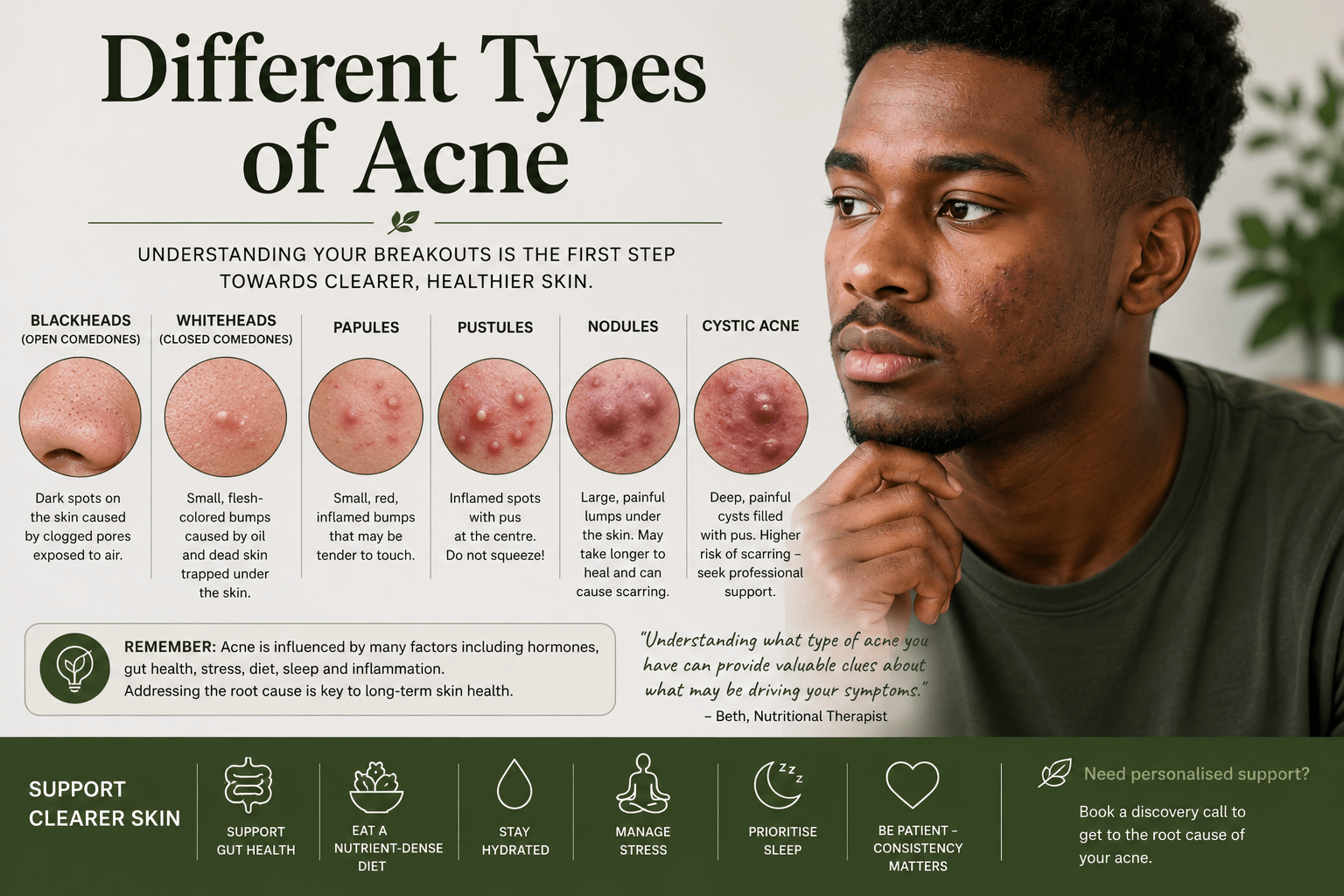
Acne may include blackheads, whiteheads, inflamed papules, pustules, nodules and cystic lesions. These different presentations can vary in severity and may require different treatment approaches (American Academy of Dermatology Association, 2023; DermNet, 2023).
While this article is not intended to diagnose your skin, it can help you recognise common acne patterns and understand when it may be time to seek professional support.
💡 In Plain English
Different types of acne can provide useful clues about what is happening in the skin. Some breakouts are mainly clogged pores, while others involve more inflammation or develop deeper beneath the skin.
✅ Key Takeaways
- The main types of acne include blackheads, whiteheads, papules, pustules, nodules and cystic acne.
- Blackheads and whiteheads are usually classed as non-inflammatory acne.
- Papules, pustules, nodules and cystic lesions involve greater levels of inflammation.
- Painful, deep or scarring acne should be assessed by a GP or dermatologist.
- Acne type, location, timing and wider symptoms may provide clues about possible contributing factors.
What Is Acne?
Acne is a common inflammatory skin condition involving the hair follicle and sebaceous gland, collectively known as the pilosebaceous unit. It can lead to blocked pores, blackheads, whiteheads, inflamed spots, nodules or cystic lesions (Sutaria, Masood and Schlessinger, 2023; Vasam, Korutla and Bohara, 2023).
Acne development is usually influenced by several interacting processes, including:
- Excess sebum production
- Blocked hair follicles
- Abnormal skin-cell build-up
- Inflammation
- Hormonal activity
- Acne-associated bacteria
- Genetic susceptibility
- Stress and lifestyle factors
Diet, gut health and wider inflammatory patterns may also be relevant for some people, although they are not considered universal causes of acne.
Acne most commonly affects areas with a higher concentration of sebaceous glands, including the face, neck, chest, back and shoulders (DermNet, 2023; Sutaria, Masood and Schlessinger, 2023).
🔬 Research Snapshot
Acne is understood as a multifactorial inflammatory skin condition. Sebum production, blocked follicles, skin-cell behaviour, acne-associated bacteria, inflammation, hormones and genetics can all contribute to its development (Sutaria, Masood and Schlessinger, 2023; Vasam, Korutla and Bohara, 2023).
The Main Types of Acne
Acne is often grouped into two broad categories:
non-inflammatory acne and
inflammatory acne.
Non-inflammatory acne generally includes blackheads and whiteheads. Inflammatory acne includes papules, pustules, nodules and cystic lesions (American Academy of Dermatology Association, 2023; DermNet, 2023).
⚫ Blackheads
Small dark dots caused by oil and dead skin cells inside an open pore. The dark colour is caused by oxidation rather than dirt.
⚪ Whiteheads
Small white or skin-coloured bumps caused by oil and dead skin cells becoming trapped beneath a closed pore.
🔴 Papules
Small red or inflamed bumps that may feel sore or tender but do not usually contain visible pus.
🟡 Pustules
Inflamed spots containing pus, often appearing as a red bump with a white or yellow centre.
🟣 Nodules
Larger, deeper and painful lumps beneath the skin that may take longer to heal and carry a greater risk of scarring.
⚠️ Cystic Acne
Deep, inflamed and painful lesions that may feel soft or fluid-filled beneath the skin and are more likely to leave scars.
1. Blackheads
Blackheads are also known as open comedones. They appear as small dark dots on the skin and are often found around the nose, chin, forehead, cheeks, chest or back.
Despite their colour, blackheads are not caused by dirt. The dark appearance develops when oil and dead skin cells inside an open pore are exposed to air and oxidise (American Academy of Dermatology Association, 2023; DermNet, 2023).
Blackheads are generally considered a milder, non-inflammatory form of acne, although they may occur alongside whiteheads or inflamed spots.
Picking or squeezing blackheads can irritate the skin and may make the surrounding area more inflamed.
💡 In Plain English
A blackhead is an open blocked pore. Its dark colour comes from a reaction with the air, not from dirt trapped in the skin.
2. Whiteheads
Whiteheads are also called closed comedones. They appear as small white, flesh-coloured or slightly raised bumps beneath the skin.
Unlike blackheads, the pore opening remains closed. This means trapped sebum and dead skin cells remain beneath the surface rather than being exposed to air (American Academy of Dermatology Association, 2023; DermNet, 2023).
Whiteheads may remain as small bumps or develop into inflamed acne if the follicle becomes irritated and inflammation increases.
A consistent skincare routine that supports healthy skin-cell turnover may be helpful, but aggressive scrubbing can increase irritation.
3. Papules
Papules are small, red or inflamed bumps. They do not usually contain visible pus, but they may feel sore, firm or tender.
Papules can develop when a blocked follicle becomes inflamed and the immune system responds to changes inside the pore (Sutaria, Masood and Schlessinger, 2023).
If you frequently experience red, inflamed bumps, it may be worth considering factors that can influence inflammation, including:
- Stress
- Poor sleep
- Hormonal patterns
- Skin-barrier irritation
- Dietary patterns
- Gut symptoms
These factors do not prove the cause of papules, but they may contribute to the wider acne pattern.
4. Pustules
Pustules are inflamed spots containing visible pus. They often appear as a red, swollen bump with a white or yellow centre.
Pustules form when inflammation and immune activity develop within an affected follicle (American Academy of Dermatology Association, 2023; Sutaria, Masood and Schlessinger, 2023).
Although pustules can be tempting to squeeze, picking or popping them may:
- Increase inflammation
- Damage surrounding skin
- Delay healing
- Increase the risk of post-inflammatory marks
- Increase the risk of scarring
Pustules are not a sign that your skin is dirty. Acne is much more complex than hygiene alone.
🌿 Good to Know
Over-washing or scrubbing pustules does not remove the cause of acne. It may damage the skin barrier and make redness, soreness and inflammation worse.
5. Nodules
Nodules are larger, deeper and more painful lumps beneath the skin. They may feel firm and can take considerably longer to heal than surface-level spots.
Nodular acne is generally considered a more severe form of inflammatory acne and carries a greater risk of scarring (American Academy of Dermatology Association, 2023; NICE, 2026).
Unlike a pustule, a nodule may not develop a visible white or yellow centre because the inflammation is located deeper within the skin.
If you are experiencing painful nodules, seek advice from a GP or dermatologist, particularly if the acne is:
- Spreading
- Becoming increasingly painful
- Leaving scars
- Not responding to over-the-counter treatment
- Affecting your confidence or mental wellbeing
6. Cystic Acne
Cystic acne involves deep, inflamed and painful lesions that may feel soft or fluid-filled beneath the skin.
This form of acne can be particularly distressing and is more likely to leave scarring or long-lasting post-inflammatory marks (American Academy of Dermatology Association, 2023; NICE, 2026).
Cystic acne may be influenced by:
- Hormonal activity
- Genetic susceptibility
- High levels of inflammation
- Excess sebum production
- Follicular blockage
- Immune responses within the skin
Hormonal patterns are often discussed in relation to cystic acne, but the condition should not automatically be assumed to have one single cause.
If you have cystic acne, professional medical support is recommended. Nutritional therapy may support the wider picture alongside medical treatment by exploring diet, digestion, stress, hormone-related patterns and nutrient status.
⚠️ When Medical Support Matters
If your acne is painful, cystic, spreading, leaving scars or causing significant distress, speak to your GP or a dermatologist. Nutritional therapy may support the wider picture, but severe or scarring acne should not be managed with nutrition and lifestyle changes alone.
Understanding what type of acne you have can provide valuable clues about what may be driving your symptoms. For example, breakouts around the jawline may prompt us to explore hormonal factors, whereas digestive symptoms alongside persistent inflammation may encourage us to look more closely at gut health.
Beth Mulvey, Registered Nutritional Therapist
Non-Inflammatory Acne vs Inflammatory Acne
The distinction between non-inflammatory and inflammatory acne can be useful when understanding your breakouts.
⚪ Non-Inflammatory Acne
- Blackheads
- Whiteheads
- Blocked pores
- Congested or uneven skin texture
- Usually less red or painful
🔴 Inflammatory Acne
- Papules
- Pustules
- Nodules
- Cystic lesions
- More redness, swelling, soreness or pain
It is possible to experience both non-inflammatory and inflammatory acne at the same time.
For example, someone may have blackheads across the nose and forehead alongside inflamed papules or pustules on the cheeks and jawline.
What Your Acne Location May Suggest
The location of acne does not provide a diagnosis, but it can sometimes offer useful clues.
📍 Chin and Jawline
Often discussed in relation to hormonal patterns, particularly when breakouts follow a cycle or appear alongside other hormone-related symptoms.
📍 Forehead
May be influenced by hair products, sweat, headwear, skincare products, friction or folliculitis-like bumps.
📍 Cheeks
May be influenced by skincare, makeup, pillowcases, phones, masks, shaving, inflammation or internal factors.
📍 Back and Chest
May be linked with sweat, friction, tight clothing, hormones, training supplements, hair products or body products.
It is important not to rely too heavily on face mapping. Acne is multifactorial, and location alone cannot reliably identify the underlying cause (Sutaria, Masood and Schlessinger, 2023).
However, location patterns may still be useful when considered alongside timing, symptoms, cycle history where relevant, digestion, diet, stress, sleep and skincare.
🌿 Good to Know
Acne location alone cannot diagnose the cause. However, location patterns can provide useful clues when reviewed alongside timing, symptoms, hormones, digestion, stress, diet and skincare.
For a full breakdown, read
Acne by Location: What Different Breakout Areas May Tell You.
You may also find these location guides helpful:
Could Acne-Like Bumps Be Something Else?
Not every spot or bump is acne vulgaris.
Some acne-like conditions may look similar but require a different approach. These may include:
- Folliculitis
- Malassezia folliculitis, often called fungal acne
- Rosacea
- Perioral dermatitis
- Ingrown hairs
- Shaving irritation
- Contact dermatitis
It may be worth seeking medical advice if the bumps are:
- Very itchy
- Burning or stinging
- Small and very similar in appearance
- Spreading quickly
- Worse after conventional acne treatments
- Associated with persistent flushing or redness
For a fuller comparison, read
Hormonal Acne vs Bacterial Acne vs Fungal Acne.
What Can Influence Different Types of Acne?
Different types of acne may have different triggers, but common contributing factors include:
- Hormonal fluctuations
- Increased sebum production
- Blocked pores
- Inflammation
- Genetic susceptibility
- High stress levels
- Poor sleep
- Blood sugar imbalance
- Gut symptoms or digestive issues
- Food triggers in some people
- Skincare products that clog or irritate pores
- Picking or squeezing spots
- Medication or supplement changes
- Sweat, friction and tight clothing
Acne is rarely explained by one of these factors alone. Several may overlap at the same time (Vasam, Korutla and Bohara, 2023).
If your acne feels hormonal, read
Foods for Hormonal Acne.
If you suspect food may be making your acne worse, read
Foods That May Trigger Acne.
For a broader overview, read
What Causes Acne?.
When Acne May Be Linked With Gut Health
Some people with acne also experience bloating, constipation, reflux, IBS-type symptoms or food sensitivities.
Gut health does not directly cause acne in everyone. However, research has explored how the gut-skin axis may influence inflammation, immune regulation, nutrient absorption and wider skin health.
Gut health may be worth considering if acne appears alongside:
- Bloating
- Constipation
- Diarrhoea or loose stools
- Reflux or indigestion
- IBS-type symptoms
- Food reactions
- Low energy
- A history of frequent antibiotic use
This does not mean gut health determines which type of acne you have. It means digestive symptoms may form part of the wider picture.
You can learn more in
Can Gut Health Cause Acne?.
For a deeper explanation, read
The Gut-Skin Axis: Why Your Skin Won’t Heal Until Your Gut Does.
How Acne Type May Affect Treatment Choices
Different acne types may respond to different treatment approaches.
For example:
⚫ Clogged Pores
Blackheads and whiteheads may respond to treatments that support exfoliation and skin-cell turnover.
🔴 Inflamed Spots
Papules and pustules may need treatment focused on inflammation and acne-associated bacteria.
🟣 Deep Lesions
Nodules and cystic acne often need medical assessment because of their depth, severity and scarring risk.
🦠 Acne-Like Bumps
Itchy, spreading or uniform bumps may require assessment for folliculitis or another condition rather than standard acne treatment.
Clinical acne guidance recommends matching treatment to acne severity, lesion type, scarring risk and individual circumstances (NICE, 2026).
For more information about skincare options, read
Acne Treatments & Skincare.
You may also find
Salicylic Acid or Benzoyl Peroxide for Acne helpful.
When to Seek Professional Support
It may be time to seek support if your acne is:
🔎 Signs You May Need Support
- Painful or cystic
- Leaving scars or persistent dark marks
- Spreading to the chest, back or neck
- Affecting your confidence or mental wellbeing
- Not improving despite consistent skincare
- Becoming progressively worse
- Linked with significant hormonal symptoms
- Very itchy, burning or unusual in appearance
NICE guidance recommends considering referral or specialist support where acne is severe, scarring, treatment-resistant or causing significant psychological distress (NICE, 2026).
For severe, painful or scarring acne, speak to your GP or a dermatologist.
Nutritional therapy may support the wider picture by exploring diet, digestion, hormones, inflammation, stress, sleep and nutrient status, but it should not replace appropriate medical treatment.
For a broader practical guide, read
How to Get Rid of Acne.
What This Means for You
Understanding your acne type can help you identify whether your breakouts mainly involve clogged pores, inflamed spots or deeper painful lesions.
It can also help you recognise when an over-the-counter skincare approach may be reasonable and when medical support is more appropriate.
However, acne type is only one part of the picture. It is also useful to consider:
- Where the acne appears
- When it flares
- Whether it is itchy, painful or cystic
- Whether it leaves marks or scars
- Whether stress or sleep affects it
- Whether digestive or hormonal symptoms occur alongside it
- Whether skincare products improve or irritate the skin
These patterns can provide more useful information than acne type alone.
✅ Key Takeaways
- Blackheads and whiteheads are usually non-inflammatory forms of acne.
- Papules and pustules involve greater inflammation.
- Nodules and cystic acne are deeper and may require medical support.
- Acne location can offer clues, but it does not confirm the cause.
- Persistent acne should be considered alongside hormones, digestion, stress, sleep, diet, skincare and inflammation.
Frequently Asked Questions
What are the main types of acne?
The main types of acne include blackheads, whiteheads, papules, pustules, nodules and cystic acne. Blackheads and whiteheads are usually non-inflammatory, while papules, pustules, nodules and cysts involve greater inflammation.
What is the difference between blackheads and whiteheads?
Blackheads are open comedones where trapped oil and dead skin cells are exposed to air and oxidise. Whiteheads are closed comedones where the pore remains covered.
What is inflammatory acne?
Inflammatory acne includes papules, pustules, nodules and cystic lesions. These spots are usually red, swollen, sore or painful because inflammation is involved.
What is the most severe type of acne?
Nodular and cystic acne are generally considered more severe because the lesions develop deeper in the skin and carry a greater risk of scarring. Medical assessment is recommended.
When should I see a doctor for acne?
Speak to your GP or a dermatologist if your acne is painful, cystic, spreading, leaving scars, not improving with treatment or affecting your confidence and mental wellbeing.
Does jawline acne mean hormones?
Jawline acne can be associated with hormonal patterns, but location alone cannot diagnose the cause. Shaving, skincare, friction, stress, digestion and inflammation may also contribute.
Can gut health affect acne type?
Gut health does not directly determine acne type. However, gut symptoms may be relevant if acne appears alongside bloating, constipation, IBS-type symptoms, food sensitivities or inflammation.
Can I have more than one type of acne?
Yes. Many people experience several types of acne at the same time, such as blackheads and whiteheads alongside papules, pustules or deeper inflamed lesions.
Final Thoughts
Understanding the different types of acne can help you make sense of your breakouts and recognise when more support may be needed.
Milder clogged pores may need a different approach from painful, inflamed, nodular or cystic acne. If your acne is persistent, recurring, painful or affecting your confidence, it is worth looking at the bigger picture rather than relying on skincare alone.
Your acne type, location, timing, symptoms and response to products can all provide useful clues about the support your skin may need.
Unsure What Type of Acne You Have?
If you feel like you have tried everything and your acne still keeps returning, personalised support can help you look deeper.
At VitaminBeth, we take a root-cause approach to acne, exploring diet, gut health, hormones, inflammation, stress and nutrient status to help identify what may be contributing to your breakouts.
Learn more about the Skin Therapy Programme
📚 Continue Your Acne Learning
You’re reading one of VitaminBeth’s acne guides. Visit the Acne Resource Centre to explore all of our evidence-informed articles on acne causes, hormones, gut health, nutrition, lifestyle and personalised support in one place.
References
- American Academy of Dermatology Association (2023) ‘How to treat different types of acne’. Available at: https://www.aad.org/public/diseases/acne/diy/types-breakouts
- DermNet (2023) ‘Acne vulgaris’. Available at: https://dermnetnz.org/topics/acne-vulgaris
- National Institute for Health and Care Excellence (NICE) (2026) ‘Acne’. Available at: https://bnf.nice.org.uk/treatment-summaries/acne/
- Sutaria, A.H., Masood, S. and Schlessinger, J. (2023) ‘Acne Vulgaris’, StatPearls. Available at: https://www.ncbi.nlm.nih.gov/books/NBK459173/
- Vasam, M., Korutla, S. and Bohara, R.A. (2023) ‘Acne vulgaris: A review of the pathophysiology, treatment, and recent nanotechnology-based advances’, Biochemistry and Biophysics Reports, 36, 101578. Available at: https://pmc.ncbi.nlm.nih.gov/articles/PMC10709101/