📚 VitaminBeth Guide
⏱️ Estimated reading time: 11–13 minutes
👩⚕️ Reviewed by Beth Mulvey, Registered Nutritional Therapist
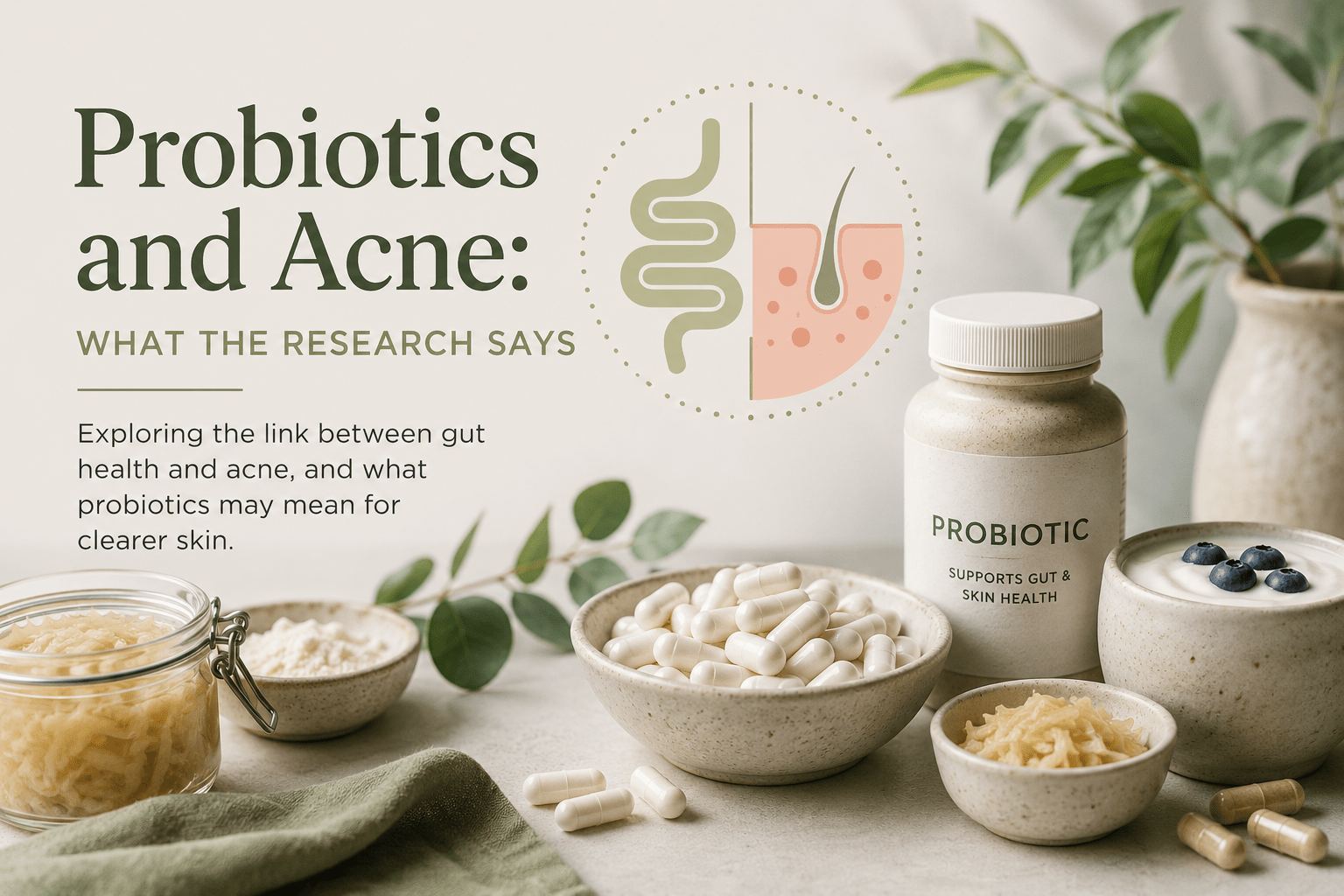
Probiotics and Acne: What the Research Says
Can probiotics help improve acne-prone skin?
Probiotics are frequently recommended online for acne, particularly when people are exploring the relationship between gut health, inflammation and the skin.
The research is promising, but the answer is not as simple as taking any probiotic and expecting acne to disappear.
Acne is a complex inflammatory skin condition. It may be influenced by hormones, sebum production, blocked follicles, skin microorganisms, inflammation, stress, sleep, diet, nutrient intake, medication and, in some people, gut health.
Probiotics may support certain pathways involved in acne, particularly through their effects on the gut microbiome, immune activity and inflammatory signalling. However, they are unlikely to address every possible acne driver and are not a replacement for appropriate skincare or medical treatment.
This guide explains what probiotics are, how they may relate to the gut-skin axis, which strains have been studied, what current research suggests, whether probiotic foods are useful and when supplements require additional care.
💡 In Plain English
Probiotics may help some people with acne, particularly when digestive health, inflammation or immune balance form part of the wider picture. However, they are not a guaranteed treatment, and different probiotic strains can have different effects.
✅ Key Takeaways
- Probiotics are live microorganisms that may provide a health benefit when consumed in appropriate amounts.
- Different probiotic strains are not interchangeable and may have different effects.
- Selected clinical trials suggest probiotics may improve acne severity in some people.
- The research remains limited because studies use different strains, doses, combinations and treatment periods.
- Fermented foods are not equivalent to probiotic supplements used in clinical research.
- Probiotics may worsen digestive symptoms in some people and are not suitable for everyone.
- They should be viewed as one possible support tool rather than a complete acne solution.
What Are Probiotics?
Probiotics are live microorganisms that may provide a health benefit when consumed in an appropriate amount.
They are commonly described as friendly or beneficial bacteria, although some probiotics are yeasts rather than bacteria.
The word probiotic does not describe one single ingredient. Each probiotic has a specific genus, species and strain.
For example:
- Lactobacillus rhamnosus may describe the genus and species.
- A further strain code identifies the exact microorganism used in a particular product or clinical study.
This distinction matters because evidence for one strain cannot automatically be applied to every other probiotic carrying the same genus name.
Probiotics, Prebiotics and Postbiotics
🦠 Probiotics
Live microorganisms that may provide a health benefit when consumed in adequate amounts.
🌾 Prebiotics
Fibres and other compounds that are used by microorganisms within the gut and may support beneficial microbial activity.
🧪 Postbiotics
Compounds produced by microorganisms or preparations containing inactivated microorganisms and their components.
🌿 Good to Know
Buying a random product because the label says “gut health” does not guarantee that it contains a strain, dose or combination studied for acne. The exact product, reason for use and individual health picture all matter.
Why Are Probiotics Linked With Acne?
Probiotics are discussed in relation to acne because of the gut-skin axis.
The gut-skin axis describes the communication between the digestive system, gut microbiome, immune system, metabolism and skin.
The gut microbiome is the community of microorganisms living within the digestive tract. These microorganisms can interact with:
- Immune activity
- Inflammatory signalling
- Gut-barrier function
- Nutrient metabolism
- Hormone metabolism
- Communication between the gut and nervous system
Research suggests that disturbances within the gut microbiome may be associated with inflammatory skin conditions, including acne. However, this does not mean that every person with acne has an unhealthy gut microbiome or that gut problems are the primary cause of all acne (Sánchez-Pellicer et al., 2022; Mahmud et al., 2022).
Probiotics may be relevant because selected strains can influence the gut environment and aspects of immune and inflammatory signalling.
Read more in The Gut-Skin Axis.
💡 In Plain English
The gut and skin can communicate through immune, metabolic and inflammatory pathways. This may help explain why gut health matters for some people with acne, although it is unlikely to be the only factor involved.
Probiotics, Inflammation and Acne
Inflammation is a central part of acne development.
Inflammatory activity may begin within the pilosebaceous unit before a spot becomes clearly visible. As acne progresses, this activity can contribute to redness, swelling, pustules, painful nodules and cysts.
Probiotics may influence inflammatory signalling through their interactions with the gut microbiome, intestinal barrier and immune system.
A randomised clinical trial published in 2024 evaluated an oral probiotic mixture in people with acne vulgaris. Participants receiving the probiotic showed improvements in acne grading and skin-related outcomes compared with placebo, suggesting that selected probiotic formulations may provide additional support for some people with acne (Eguren et al., 2024).
However, this finding does not mean that all probiotic products will have the same effect. The trial investigated a specific combination of microorganisms, dose and treatment period.
More recent systematic reviews and meta-analyses have also reported possible improvements in inflammatory and total acne lesions. However, the researchers noted variation between the studies, including differences in probiotic strains, formulations, treatment durations, participant characteristics and outcome measurements (Mohamed et al., 2025; Tjiu et al., 2025).
🔬 Research Snapshot
- Selected probiotic formulations have improved acne outcomes in some randomised trials.
- Meta-analyses suggest probiotics may reduce inflammatory or total acne lesions in some people.
- Benefits may depend on the exact strain or combination rather than probiotics as a general category.
- Studies vary considerably in their doses, products, treatment periods and outcome measures.
- Many trials remain relatively small or short term.
- Probiotics are best considered as a possible adjunct rather than a replacement for evidence-based acne treatment.
(Eguren et al., 2024; Mohamed et al., 2025; Tjiu et al., 2025).
Overall, the research is encouraging, but it is not yet strong enough to recommend one universal probiotic treatment for everyone with acne.
Probiotics and Gut-Barrier Function
The gut barrier is the lining of the digestive tract. It helps absorb nutrients while regulating which substances pass from the gut into the body.
Gut-barrier function is influenced by many factors, including:
- The gut microbiome
- Dietary fibre
- Inflammation
- Infections
- Alcohol intake
- Medication
- Stress
- Sleep
- Certain gastrointestinal conditions
Some probiotic strains may support aspects of gut-barrier and immune function. This is one proposed mechanism through which probiotics could influence inflammatory skin conditions (Sánchez-Pellicer et al., 2022; Mahmud et al., 2022).
However, terms such as “leaky gut” are often used too broadly online. Common symptoms such as bloating or constipation do not, by themselves, confirm impaired intestinal permeability.
Probiotics are also only one possible part of digestive support. Diet quality, fibre intake, meal regularity, sleep, stress, medication, digestive function and underlying gastrointestinal conditions may all matter.
Read more in Can Gut Health Cause Acne? and The Link Between Nutrition and Gut Health.
Can Probiotics Help Hormonal Acne?
Hormonal acne may be influenced by androgen activity, menstrual-cycle changes, sebum production, insulin signalling, stress and conditions such as PCOS.
Probiotics may indirectly support some people with hormone-related acne if gut health, inflammation or blood sugar regulation form part of the wider picture.
However, probiotics are unlikely to correct significant androgen excess, PCOS or another underlying hormone condition on their own.
Clues that acne may have a hormonal component can include:
- Breakouts around the chin, jawline or lower face
- Flares before or during menstruation
- Irregular or absent periods
- Excess facial or body hair
- Thinning scalp hair
- Difficulty managing blood sugar or strong cravings
These features do not provide a diagnosis by themselves, but they may justify further assessment.
Read Foods for Hormonal Acne and Acne and PCOS.
🌿 Good to Know
Probiotics may support one part of the wider picture, but they should not be presented as a standalone hormonal-acne treatment.
Which Probiotic Strains Have Been Studied for Acne?
Acne research has explored several probiotic species and multi-strain combinations, including microorganisms from the Lactobacillus and Bifidobacterium groups.
Examples discussed within acne and skin-health research include:
- Lactobacillus rhamnosus
- Lactobacillus acidophilus
- Lactobacillus plantarum
- Lactobacillus paracasei
- Bifidobacterium lactis
Some bacterial names have been reclassified within scientific literature, so modern product labels may use newer genus names. This can make direct comparisons between older studies and current products more difficult.
It is also important to understand that evidence for one named strain cannot be assumed to apply to another strain of the same species.
What to Check on a Probiotic Label
🔬 Full Strain Name
Look for the genus, species and, where available, the strain code rather than a general statement such as “contains Lactobacillus”.
🔢 Amount Provided
Products often state colony-forming units, usually abbreviated to CFU. More is not automatically better.
📅 Viability
Check whether the stated amount applies at manufacture or at the end of the product’s shelf life.
🌡️ Storage Instructions
Some products require refrigeration, while others are designed to remain stable at room temperature.
🧾 Other Ingredients
Check for sweeteners, fibres, dairy, allergens or other ingredients that may affect tolerance.
📚 Evidence for Use
Consider whether the exact strain or formulation has evidence for the reason you are taking it.
🌿 Good to Know
There is currently no single probiotic that can be described as the best probiotic for acne. The evidence is specific to particular formulations, and individual responses vary.
Can Probiotics Make Acne Worse?
Some people report that their skin or digestive symptoms worsen after starting a probiotic.
This does not necessarily mean that probiotics directly cause acne, but worsening symptoms should not be dismissed.
Possible explanations include:
- Temporary changes in wind or bowel habits
- Sensitivity to the particular strain or formulation
- Reaction to added fibres, sweeteners, dairy or other ingredients
- Poor tolerance of fermented products
- Coincidental hormonal, dietary or stress-related flare-ups
- An underlying digestive condition that requires assessment
Some people describe worsening symptoms as a “detox” or “die-off” reaction. However, there is limited high-quality evidence that a significant acne flare after starting probiotics should routinely be interpreted this way.
If your skin or digestion becomes noticeably worse, consider stopping the product and discussing the reaction with an appropriate healthcare professional.
New or persistent symptoms should not be endured because a product is assumed to be “working”.
Probiotic and Fermented Foods
Some foods contain live microorganisms or are produced through fermentation.
🥣 Fermented Dairy Foods
- Live yoghurt
- Kefir
- Some cultured dairy products
🥬 Fermented Vegetables
- Sauerkraut
- Kimchi
- Traditionally fermented vegetables
Fermented Foods Are Not the Same as Probiotic Supplements
A fermented food is not automatically a clinically tested probiotic.
The microorganisms in fermented foods may vary between products, batches and storage conditions. Some products are also pasteurised after fermentation, meaning they may no longer contain live microorganisms.
Clinical trials generally use specifically identified strains in measured amounts. A portion of kimchi, yoghurt or kombucha cannot be assumed to provide an equivalent effect.
Fermented foods may still form part of a varied diet where tolerated, but they should not be presented as a proven acne treatment.
🌿 Good to Know
Live yoghurt, kefir and fermented vegetables may support dietary variety, but their microorganisms, amounts and effects differ from the probiotic supplements used in acne research.
How to Support the Gut Microbiome Through Food
Probiotic products are only one part of supporting the gut environment.
🌾 Increase Fibre Gradually
Include vegetables, fruit, oats, wholegrains, beans, lentils, nuts and seeds where tolerated. Increase fibre gradually to reduce the risk of discomfort.
🌈 Eat a Variety of Plants
Different plant foods provide different fibres and compounds that may support microbial diversity.
🫘 Include Legumes
Beans, chickpeas and lentils provide fermentable fibres, although portion size may need adjusting for digestive tolerance.
💧 Drink Enough Fluid
Adequate hydration is particularly important when increasing dietary fibre.
🍽️ Eat Regular Balanced Meals
Meal regularity and balanced food choices may support digestion, energy and blood sugar regulation.
😴 Consider Sleep and Stress
The gut and nervous system communicate in both directions. Ongoing stress and poor sleep may influence digestive symptoms and eating habits.
Read Foods That May Trigger Acne before removing foods unnecessarily.
🔎 Signs Gut Health May Be Worth Exploring
Gut health may be worth reviewing if acne appears alongside:
- Persistent bloating
- Constipation or diarrhoea
- Diagnosed IBS
- Reflux or indigestion
- Frequent abdominal pain
- Food-related digestive symptoms
- Frequent or recent antibiotic use
- Unexplained fatigue or concerns about nutrient status
These symptoms do not prove that gut health is causing acne. They may have several explanations and may require appropriate medical assessment.
Should You Take a Probiotic Supplement for Acne?
A probiotic may be worth considering for some people, particularly where acne appears alongside digestive symptoms or where a specific strain has evidence relevant to the person’s needs.
However, probiotic supplements should not be chosen solely according to the number of strains or the highest CFU count.
Before choosing a product, consider:
- The full strain names
- The evidence for those strains
- The amount provided
- The recommended treatment period
- Storage requirements
- Added prebiotic fibres
- Allergens and other ingredients
- Your digestive symptoms
- Your medical history
- Any medication or treatment you currently use
It can also be useful to introduce one product at a time. Starting several supplements together makes it difficult to understand which product is helping or causing symptoms.
⚠️ Supplement Safety: Probiotics
Probiotics are generally well tolerated by many healthy people, but they are not suitable for everyone.
Seek medical advice before taking a live probiotic supplement if you:
- Are significantly immunocompromised
- Are severely or critically unwell
- Have a central venous catheter
- Are receiving chemotherapy or another immune-suppressing treatment
- Have recently had major surgery
- Have severe pancreatitis
- Have a serious or complex gastrointestinal condition
- Have previously been advised to avoid live microbial products
Rare cases of bloodstream infection associated with probiotic microorganisms have been reported in medically vulnerable people. This risk is low for most healthy adults but is important in higher-risk clinical situations.
People with significant bloating, suspected small intestinal bacterial overgrowth, complex food reactions or poor tolerance of fermented foods may also require a more personalised approach.
With acne, I rarely look at one supplement in isolation. Probiotics can be useful in the right context, but the key is understanding why someone’s skin is struggling and whether gut health is genuinely part of that picture.
Beth Mulvey, Registered Nutritional Therapist
Probiotics Are Only One Piece of the Acne Puzzle
Probiotics may influence gut and immune pathways, but acne rarely develops because of one issue alone.
Other important contributors may include:
- Hormonal changes
- Genetics
- Sebum production
- Blocked follicles
- Skin microorganisms
- Skincare products
- Medication
- Stress
- Sleep
- Dietary patterns
- Blood sugar regulation
- Wider nutrient intake
You may also find these guides useful:
When to Speak to Your GP
Probiotics and dietary changes should not replace appropriate medical assessment.
Speak to your GP or another appropriate healthcare professional if:
- Your acne is painful, nodular, cystic or scarring
- Your acne has suddenly become much worse
- Your acne is affecting your confidence or emotional wellbeing
- You have persistent diarrhoea or vomiting
- You have blood in your stool
- You are losing weight without trying
- You have persistent or severe abdominal pain
- You are immunocompromised or receiving cancer treatment
- You are considering probiotics for a child or medically vulnerable person
- Your digestive symptoms are persistent or unexplained
⚠️ When to Get Medical Support
Seek medical support for severe, painful or scarring acne. Persistent digestive symptoms, unexplained weight loss, rectal bleeding or significant changes in bowel habits should also be assessed rather than treated with supplements alone.
What This Means for You
Probiotics may be worth considering when acne appears alongside digestive symptoms, recent antibiotic use or a wider pattern involving gut health and inflammation.
However, the question is not simply:
Which probiotic should I take for acne?
A more useful set of questions is:
- Are digestive symptoms actually part of my acne pattern?
- Does the product contain a clearly identified strain?
- Has that strain been studied for a relevant purpose?
- Could another ingredient in the product worsen my symptoms?
- Are hormones, skincare, medication, stress or diet more important contributors?
- Is a probiotic safe for my medical circumstances?
For some people, a targeted probiotic may provide useful support. For others, improving dietary fibre, meal quality, sleep, stress management or medical acne treatment may be more relevant.
A personalised approach helps avoid spending money on supplements that do not address the main problem.
For a broader starting point, read How to Get Rid of Acne. You can also read the Acne Case Study to see how a wider approach may work in practice.
Frequently Asked Questions
Do probiotics help acne?
Selected probiotic formulations have improved acne outcomes in some clinical trials. However, probiotics do not work for everyone, and benefits may depend on the specific strains, dose and individual acne pattern.
How long do probiotics take to work for acne?
Many studies assess probiotics over approximately 8 to 12 weeks, although treatment periods vary. Improvements are not guaranteed, and probiotics should not delay appropriate acne treatment.
Can probiotics make acne worse?
Some people notice worse skin or digestive symptoms after starting a probiotic. This may relate to the product, additional ingredients, individual tolerance or coincidental acne fluctuations. Persistent worsening should not automatically be considered a detox reaction.
What is the best probiotic for acne?
There is no single best probiotic for acne. Evidence relates to specific strains and combinations, and the most appropriate option depends on the individual’s symptoms, medical history and wider acne pattern.
Can probiotic foods help acne?
Fermented foods may support dietary variety and gut health for some people. However, they do not provide standardised strains or amounts and should not be considered equivalent to probiotic supplements used in clinical research.
Are probiotics good for hormonal acne?
Probiotics may indirectly support hormone-related acne where gut health, inflammation or blood sugar regulation are relevant. They are unlikely to resolve significant androgen excess, PCOS or another hormonal condition by themselves.
Can I take probiotics with antibiotics?
Some probiotics are used alongside antibiotics, but the evidence and recommended timing vary by strain and product. Speak to a pharmacist or healthcare professional for advice relevant to your medication and health.
Should teenagers with acne take probiotics?
Teenagers should not be encouraged to take supplements without appropriate guidance from a parent, guardian, pharmacist or healthcare professional. Adolescent acne is common and may require suitable skincare or medical treatment rather than probiotics.
Final Thoughts
Probiotics and acne represent a promising area of gut-skin research.
Selected probiotic formulations have improved acne outcomes in some clinical trials, while systematic reviews and meta-analyses suggest possible benefits for inflammatory and total acne lesions (Eguren et al., 2024; Mohamed et al., 2025; Tjiu et al., 2025).
However, the evidence does not show that every probiotic product will improve acne.
Different strains have different characteristics, studies use varied formulations, and individual responses are likely to depend on the person’s gut health, acne type, diet, medication and wider health picture.
Probiotic foods and supplements are also not interchangeable. Fermented foods may form part of a varied diet, but they do not necessarily contain the same strains or measured amounts used in clinical studies.
Probiotics are therefore best viewed as one possible support tool. They are unlikely to overcome significant hormonal drivers, unsuitable skincare, severe acne, chronic stress or an underlying digestive condition on their own.
Understanding what is contributing to your acne is usually more valuable than simply adding another supplement.
✅ Key Takeaways
- Selected probiotics may improve acne outcomes for some people.
- Benefits are likely to be strain- and product-specific.
- Current studies vary in quality, size, dose and duration.
- Fermented foods are not equivalent to clinical probiotic products.
- Worsening symptoms should not automatically be described as detoxification.
- Probiotics require additional caution in medically vulnerable people.
- Persistent acne usually needs a wider evidence-informed approach.
Ready to Understand What May Be Driving Your Acne?
If you are struggling with persistent acne, digestive symptoms, hormone-related breakouts, fatigue or recurring skin flare-ups, you do not have to keep guessing which food or supplement to try next.
At VitaminBeth, we use a personalised approach to explore the factors that may be contributing to acne, including gut health, hormones, nutrition, digestion, inflammation, stress and lifestyle.
The aim is not to recommend probiotics or other supplements in isolation. It is to understand the wider pattern and create a realistic nutrition and lifestyle plan around your individual needs.
Learn more about the Skin Therapy Programme
📚 Continue Your Acne Learning
You’re reading one of VitaminBeth’s acne guides. Visit the Acne Resource Centre to explore all of our evidence-informed articles on acne causes, hormones, gut health, nutrition, lifestyle and personalised support in one place.
References
- Eguren, C. et al. (2024) ‘A randomized clinical trial to evaluate the efficacy of an oral probiotic in acne vulgaris’, Acta Dermato-Venereologica. Available at: https://pmc.ncbi.nlm.nih.gov/articles/PMC11110809/
- Mahmud, M.R. et al. (2022) ‘Impact of gut microbiome on skin health: Gut-skin axis observed through the lenses of therapeutics and skin diseases’, Gut Microbes. Available at: https://www.tandfonline.com/doi/full/10.1080/19490976.2022.2096995
- Mohamed, M. et al. (2025) ‘The impact of probiotics on acne vulgaris: A meta-analysis of randomized controlled trials’, Cureus. Available at: https://pmc.ncbi.nlm.nih.gov/articles/PMC12709052/
- Sánchez-Pellicer, P. et al. (2022) ‘Acne, microbiome, and probiotics: The gut-skin axis’, Microorganisms. Available at: https://pmc.ncbi.nlm.nih.gov/articles/PMC9318165/
- Tjiu, J.W. et al. (2025) ‘Oral probiotics in acne vulgaris: A systematic review and meta-analysis’, Medicina. Available at: https://pmc.ncbi.nlm.nih.gov/articles/PMC12734792/