📚 VitaminBeth Guide
⏱️ Estimated reading time: 7–9 minutes
👩⚕️ Reviewed by Beth Mulvey, Registered Nutritional Therapist
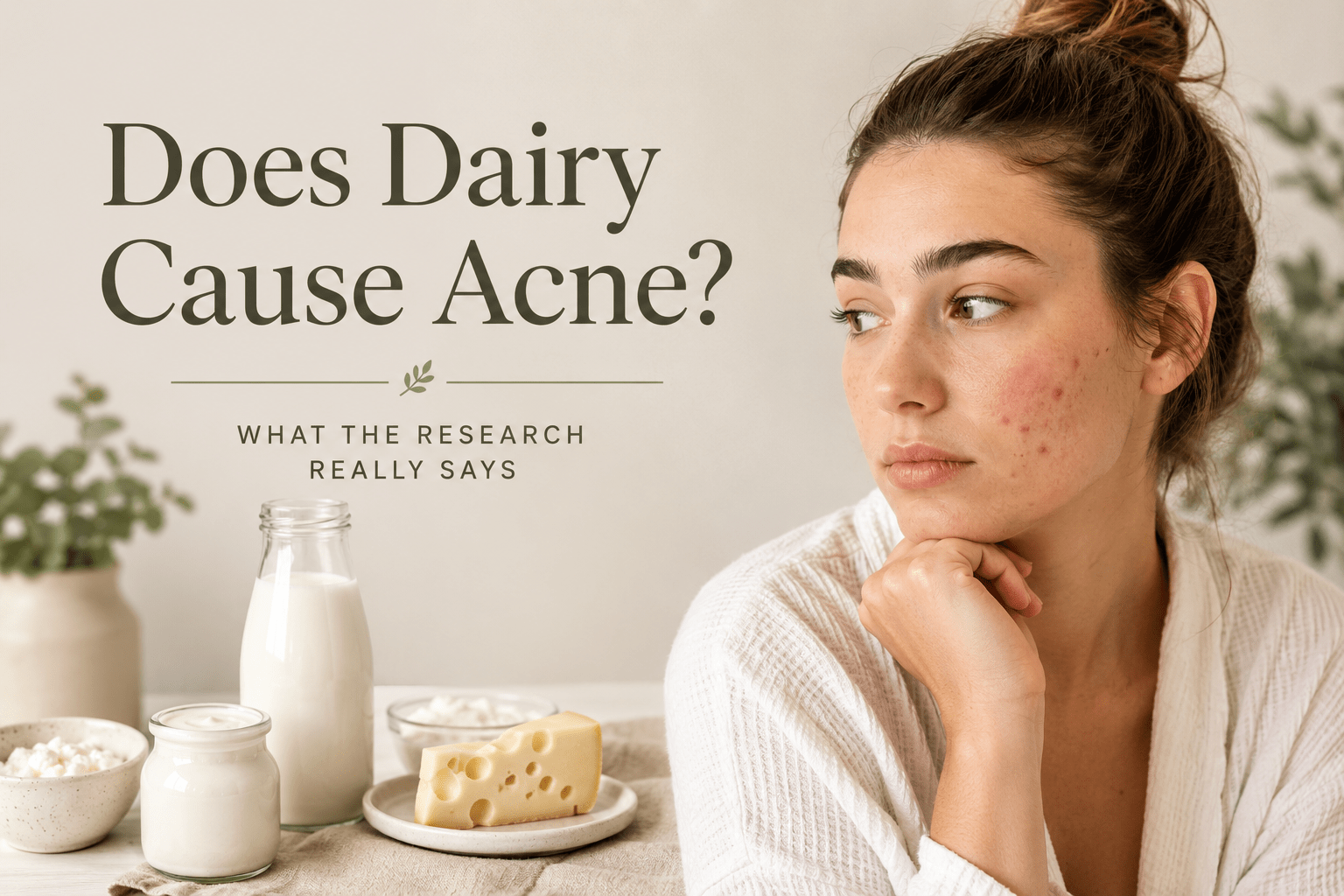
Does Dairy Cause Acne?
If you have acne, you may have wondered whether dairy is making your skin worse. It is one of the most common questions people ask when they are trying to understand why their breakouts keep coming back.
The honest answer is this:
dairy does not directly cause acne in everyone, but research suggests it may contribute to acne symptoms in some people, especially those who are already prone to breakouts (Juhl
et al., 2018; Meixiong and Bhutani, 2022).
Acne is rarely caused by one single food. It is usually influenced by a combination of hormones, inflammation, stress, blood sugar balance, gut health, genetics and lifestyle. However, for some people, dairy can be one piece of the puzzle.
💡 In Plain English
Dairy does not cause acne for everyone. But for some people, especially those already prone to breakouts, milk or whey protein may make acne worse. The goal is not to panic or cut everything out, but to understand your personal pattern.
✅ Key Takeaways
- Dairy does not directly cause acne in everyone.
- Research suggests dairy may contribute to acne symptoms in some people.
- The strongest research links are usually seen with milk, especially skimmed or low-fat milk.
- Whey protein may trigger breakouts in some people.
- If you suspect dairy is affecting your skin, a short structured trial is more helpful than guessing.
What Does the Research Say About Dairy and Acne?
A large systematic review and meta-analysis found an association between dairy intake and acne in children, teenagers and young adults. This does not prove that dairy directly causes acne, but it does suggest there may be a relationship worth paying attention to (Juhl
et al., 2018).
Other research has also found a positive association between milk consumption and teenage acne, particularly with milk intake in adolescent girls (Adebamowo
et al., 2006).
More recent reviews have continued to suggest that dairy may be acne-promoting in some people, especially when combined with a typical Western diet that is higher in refined carbohydrates and high-glycaemic foods (Meixiong and Bhutani, 2022).
In simple terms, the research does not say that everyone with acne must avoid dairy. But it does suggest that dairy may be worth investigating if your acne is persistent, inflamed or not improving despite a good skincare routine.
🔬 Research Snapshot
Research has found an association between dairy intake and acne, particularly milk consumption. However, this does not prove that dairy causes acne in everyone, and the relationship may depend on the person, the type of dairy and the wider diet (Juhl et al., 2018; Meixiong and Bhutani, 2022).
Why Might Dairy Affect Acne?
There are a few possible reasons why dairy may affect the skin.
📈 1. Insulin and IGF-1
Milk can influence insulin and insulin-like growth factor 1, also known as IGF-1. These hormones are involved in growth, but they may also influence oil production, inflammation and the behaviour of skin cells involved in acne development.
🥛 2. Skimmed Milk
The link between dairy and acne appears stronger for skimmed or low-fat milk than for full-fat dairy in some studies. This may be because skimmed milk has a different hormonal and protein profile, although more research is needed.
💪 3. Whey Protein
Whey protein is found in dairy and is also commonly used in protein powders. Some people notice acne flare-ups when using whey protein supplements, especially around the jawline, cheeks, back or chest.
1. Dairy May Influence Insulin and IGF-1
Milk can influence insulin and insulin-like growth factor 1, also known as IGF-1. These hormones are involved in growth, but they may also influence oil production, inflammation and the behaviour of skin cells involved in acne development (Melnik and Schmitz, 2009).
Higher IGF-1 activity has been linked with increased sebum production and changes in the skin that may contribute to blocked pores and breakouts (Melnik and Schmitz, 2009).
💡 In Plain English
Milk may affect acne-related pathways in some people by influencing insulin and IGF-1. These can affect oil production, inflammation and how skin cells behave inside the pore.
2. Skimmed Milk May Be More Strongly Linked
Interestingly, the link between dairy and acne appears stronger for skimmed or low-fat milk than for full-fat dairy in some studies. This may be because skimmed milk has a different hormonal and protein profile, although more research is needed (Adebamowo
et al., 2006; Juhl
et al., 2018).
3. Whey Protein May Trigger Breakouts in Some People
Whey protein is found in dairy and is also commonly used in protein powders. Some people notice acne flare-ups when using whey protein supplements, especially around the jawline, cheeks, back or chest (Meixiong and Bhutani, 2022).
This does not mean protein powder is bad for everyone, but if your skin worsened after starting whey protein, it may be worth reviewing.
Is Cheese or Yoghurt as Bad as Milk?
Not all dairy appears to affect the skin in the same way.
The strongest associations in the research are usually seen with milk, particularly skimmed milk. The evidence around cheese and yoghurt is less consistent (Juhl
et al., 2018; Meixiong and Bhutani, 2022).
Fermented dairy products such as live yoghurt may affect the body differently because they can contain beneficial bacteria. For some people, yoghurt may be well tolerated. For others, it may still trigger symptoms.
This is why it is important not to make blanket rules. Your skin, digestion, hormones and immune system all matter.
🌿 Good to Know
Milk, cheese, yoghurt and whey protein may not affect the skin in the same way. If dairy is a trigger for you, it may be specific to one type rather than every dairy food.
When someone comes to me with acne, I don’t usually look at one food in isolation. Dairy can be a trigger for some people, but the bigger question is why the skin is reacting in the first place. That means looking at hormones, gut health, inflammation, stress, blood sugar balance and the person’s full diet.
Beth Mulvey, Registered Nutritional Therapist
Should You Cut Out Dairy for Acne?
You do not need to cut out dairy forever just because you have acne.
However, if you suspect dairy may be affecting your skin, a short, structured trial can be helpful.
🔎 A Sensible Dairy Trial May Include
- Keeping a food and skin diary for 2–4 weeks
- Removing dairy for 4–6 weeks
- Monitoring changes in breakouts, redness and inflammation
- Reintroducing dairy gradually
- Noticing whether symptoms return
This gives you clearer information than guessing or cutting out multiple foods at once.
If you do remove dairy, make sure your diet still contains enough calcium, iodine, protein and other key nutrients. This is especially important for teenagers, pregnant women, breastfeeding women and anyone with a restricted diet.
⚠️ A Balanced Note
Do not remove dairy long term without thinking about nutrients such as calcium, iodine and protein. This is especially important for teenagers, pregnant women, breastfeeding women and anyone with an already restricted diet.
What Else Could Be Driving Acne?
Dairy may be one factor, but acne often has deeper root causes.
Other common contributors include:
- Hormonal changes or imbalances
- High stress levels
- Poor sleep
- Blood sugar spikes
- Digestive issues
- Constipation or poor elimination
- Low intake of key nutrients such as zinc, omega-3 fats and vitamin A
- Inflammation in the body
This is why acne often improves most when you look beyond the surface of the skin.
If you want to understand this in more detail, you may also find this article helpful:
The Gut-Skin Axis: Why Your Skin Won’t Heal Until Your Gut Does.
You may also find
Foods That May Trigger Acne,
Foods for Hormonal Acne and
How to Get Rid of Acne helpful.
So, Does Dairy Cause Acne?
Dairy does not cause acne for everyone. But for some people, especially those already prone to breakouts, milk and whey-based products may make acne worse (Juhl
et al., 2018; Meixiong and Bhutani, 2022).
The key is not to panic or remove foods randomly. The best approach is to understand your personal triggers and look at the bigger picture of your health.
If your acne keeps coming back, it may be a sign that your body needs support from the inside out.
✅ Key Takeaways
- Dairy is not a universal acne trigger.
- Milk and whey protein appear more relevant than cheese or yoghurt for some people.
- A short, structured dairy trial can help you understand whether dairy affects your skin.
- Long-term restriction should be done carefully to avoid nutrient gaps.
- Persistent acne usually needs a wider root-cause approach.
Frequently Asked Questions
Does dairy cause acne for everyone?
No. Dairy does not cause acne for everyone. Research suggests dairy may contribute to acne symptoms in some people, especially those already prone to breakouts, but individual responses vary.
Which dairy is most linked with acne?
The strongest associations are usually seen with milk, particularly skimmed or low-fat milk. The evidence around cheese and yoghurt is less consistent.
Can whey protein cause acne?
Whey protein may trigger acne flare-ups in some people, especially around the jawline, cheeks, chest or back. If your acne worsened after starting whey protein, it may be worth reviewing.
Should I cut out dairy if I have acne?
Not automatically. If you suspect dairy is affecting your skin, a short structured trial followed by gradual reintroduction may give clearer information than cutting it out forever.
How long should I remove dairy to test acne?
A trial of around 4–6 weeks may be useful for some people, ideally after keeping a food and skin diary first. Reintroducing dairy gradually can help you see whether symptoms return.
Is yoghurt bad for acne?
Yoghurt does not appear to have the same level of evidence as milk. Some people tolerate live yoghurt well, while others may still notice symptoms. Individual response matters.
What should I replace dairy with?
If removing dairy, it is important to consider calcium, iodine, protein and overall diet quality. Fortified alternatives may help, but the best choice depends on your diet and health needs.
Final Thoughts
Dairy does not cause acne for everyone, and it is not the only factor to consider.
However, milk and whey protein may worsen symptoms in some people, especially where acne is already persistent, inflamed or hormone-related.
The most helpful approach is not fear or restriction. It is to notice patterns, test changes sensibly and look at the wider picture, including hormones, gut health, inflammation, stress, blood sugar balance and nutrient status.
Struggling With Persistent Acne?
If you feel like you have tried every skincare product and your acne still keeps coming back, it may be time to look deeper.
At VitaminBeth, we use a personalised, root-cause approach to help identify what may be contributing to your skin symptoms, including gut health, hormones, inflammation, stress, diet and nutrient status.
Learn more about the Skin Therapy Programme
📚 Continue Your Acne Learning
You’re reading one of VitaminBeth’s acne guides. Visit the Acne Resource Centre to explore all of our evidence-informed articles on acne causes, hormones, gut health, nutrition, lifestyle and personalised support in one place.
References
- Adebamowo, C.A. et al. (2006) ‘Milk consumption and acne in adolescent girls’, Dermatology Online Journal, 12(4), p. 1. Available at: https://pubmed.ncbi.nlm.nih.gov/17083856/
- Juhl, C.R. et al. (2018) ‘Dairy intake and acne vulgaris: A systematic review and meta-analysis of 78,529 children, adolescents, and young adults’, Nutrients, 10(8), p. 1049. Available at: https://pubmed.ncbi.nlm.nih.gov/30096883/
- Meixiong, J. and Bhutani, T. (2022) ‘Diet and acne: A systematic review’, JAAD International, 7, pp. 95–112. Available at: https://pmc.ncbi.nlm.nih.gov/articles/PMC8971946/
- Melnik, B.C. and Schmitz, G. (2009) ‘Role of insulin, insulin-like growth factor-1, hyperglycaemic food and milk consumption in the pathogenesis of acne vulgaris’, Experimental Dermatology, 18(10), pp. 833–841. Available at: https://pubmed.ncbi.nlm.nih.gov/19709092/