📚 VitaminBeth Guide
⏱️ Estimated reading time: 9–11 minutes
👩⚕️ Reviewed by Beth Mulvey, Registered Nutritional Therapist
Acne by Location: What Different Breakout Areas May Tell You
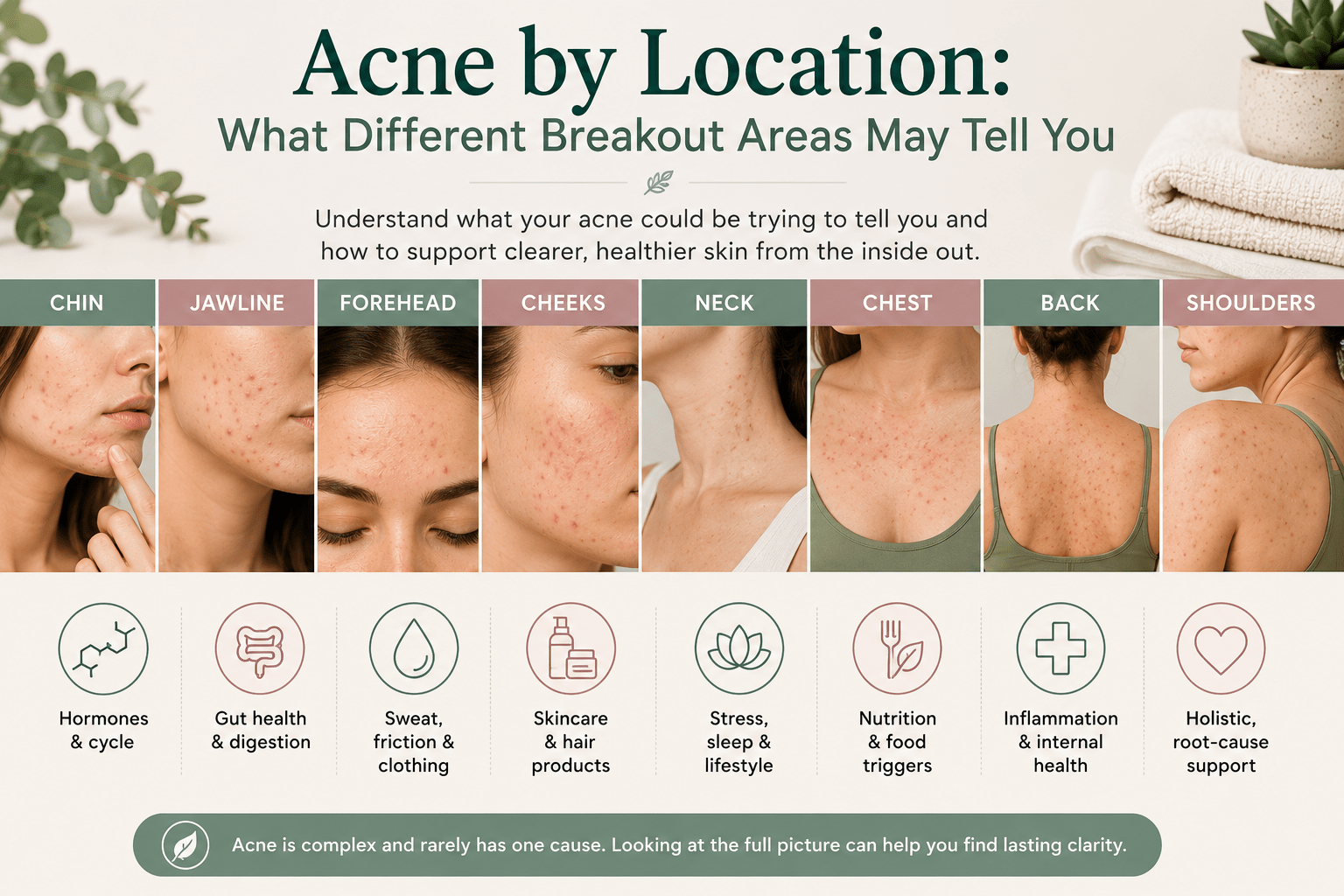
Acne can appear on many areas of the face and body, including the chin, jawline, forehead, cheeks, neck, chest, back and shoulders.
It is natural to wonder whether the location of your acne means something. For example, you may have heard that chin acne is hormonal, forehead acne is linked with digestion, or back acne is caused by sweat.
The truth is more nuanced.
Acne location can offer context, but it does not provide a diagnosis on its own. Acne develops through interacting processes involving the hair follicle and oil gland, sebum, follicular blockage, inflammation, microbes, hormones and genetic susceptibility. Products, medicines, friction and occlusion may also affect some patterns (DermNet, 2021).
💡 In Plain English
Where spots appear can help describe the pattern and identify possible contact or friction factors. It cannot tell you the cause by itself. The type of lesion, timing, severity, symptoms, products, medicines and wider health history all matter.
✅ Key Takeaways
- Acne location can provide clues, but it cannot diagnose the cause by itself.
- Chin and jawline acne may be linked with hormonal patterns in some people.
- Forehead acne may be influenced by hair products, sweat, hats, skincare or irritation.
- Chest, back and shoulder acne may involve sweat, friction, body products, hormones or folliculitis.
- Persistent, painful, cystic or scarring acne should be assessed by a GP or dermatologist.
🔬 Research Snapshot
Acne commonly affects the face and can also involve the neck, chest and back. Distribution is relevant when assessing severity and selecting treatment, but evidence does not support using a strict face map to diagnose internal causes. In adult women, persistent lower-face, jawline or neck acne can be compatible with a hormonal pattern, especially when it flares predictably around the menstrual cycle, but location alone is not diagnostic (American Academy of Dermatology Association, n.d.; DermNet, 2021; NICE, 2026).
Can Acne Location Really Tell You the Cause?
Acne location can be helpful, but it should not be treated like a strict map.
For example, persistent acne on the lower face or jawline can be compatible with a hormonal pattern in some adult women, particularly when it flares around the menstrual cycle. The same location can also be affected by products, shaving, friction or medicines, so the pattern still needs individual assessment (American Academy of Dermatology Association, n.d.).
Similarly, spots on the back may be acne vulgaris, but sweat, friction, occlusive products and acne-like conditions such as folliculitis can affect the appearance or distribution. Location alone cannot distinguish them (DermNet, 2020; DermNet, 2021).
The most useful question is not only
“Where is my acne?”
It is also:
- When does it flare?
- Is it painful, itchy, cystic or inflamed?
- Does it worsen around your cycle?
- Does it appear after sweating, gym sessions or tight clothing?
- Do you have menstrual changes, excess hair growth, medicine changes or other symptoms that need separate assessment?
- Has it changed after skincare, supplements or medication?
🌿 Good to Know
Face mapping is often oversimplified. Acne location should be considered alongside the lesion type, severity, timing, menstrual pattern where relevant, medicines, skincare, friction and other symptoms. It should never be used to diagnose an internal condition.
Quick Guide: Acne by Location
🔎 Chin Acne
In adult women, a persistent lower-face pattern may be compatible with hormonal acne, particularly when it flares around the menstrual cycle. Location alone cannot confirm this.
🔎 Jawline Acne
May form part of a lower-face hormonal pattern in some adult women, but shaving, skincare and friction can also affect this area.
🧴 Forehead Acne
Hair products, occlusive skincare, sweat, hats or helmets may affect the forehead and hairline. Uniform itchy bumps may need assessment for folliculitis.
🫧 Cheek Acne
Skincare, cosmetics, repeated contact and irritation may affect the cheeks. Redness, flushing or burning may suggest another condition that needs assessment.
🪒 Neck Acne
Shaving, hair products, sweat, collars and friction may affect the neck. Lower-face and neck acne can also occur in hormonal patterns in some adult women.
👕 Chest Acne
Sweat, tight clothing, friction and occlusive body products may affect the chest. Folliculitis can resemble acne in this area.
🎒 Back Acne
Sweat, friction, clothing, backpacks, hair products and occlusive body products may affect the back. Folliculitis can resemble acne.
🏋️ Shoulder Acne
Sweat, straps, gym clothing, friction and body or hair products may affect the shoulders, often as part of a wider chest or back pattern.
Chin Acne
Chin acne is one of the most commonly discussed acne locations, especially when people are trying to understand hormonal acne.
Breakouts on the chin may appear as clogged pores, inflamed spots or deeper painful nodules. Some adult women notice lower-face acne that flares predictably around the menstrual cycle, but this pattern does not confirm a hormonal disorder (American Academy of Dermatology Association, n.d.).
Possible contributors may include:
- Menstrual or other hormonal changes in some women
- Androgen activity
- Touching the face or resting the chin on hands
- Skincare or makeup irritation
If acne appears alongside irregular periods, excess facial or body hair or scalp hair thinning, discuss the wider pattern with your GP. These features may warrant assessment, but acne location cannot diagnose PCOS.
Read the full guide:
Chin Acne.
You may also find
Foods for Hormonal Acne and
Acne and PCOS helpful.
Jawline Acne
Jawline acne is another common hormonal acne pattern. It may appear along the lower face, jaw, under the jaw or towards the neck.
Some adult women notice jawline acne that flares cyclically. Products, shaving, friction, medicines and changes in hormonal contraception may also be relevant and should be considered separately.
Possible contributors may include:
- Androgen activity
- Stress
- Skincare or makeup products
- Shaving irritation
- Friction from masks, helmets or clothing
Persistent jawline acne may need a treatment review. A clinician can assess the acne type, severity, medicines and any signs that warrant hormonal evaluation.
Read the full guide:
Jawline Acne.
For a broader comparison, read
Hormonal Acne vs Bacterial Acne vs Fungal Acne.
Forehead Acne
Forehead acne can appear as small bumps, clogged pores, blackheads, whiteheads or inflamed spots.
This area can be affected by several external factors because the forehead is close to the hairline and often exposed to sweat, hair products, hats, helmets and skincare.
Possible contributors may include:
- Hair oils, gels, sprays or leave-in products
- Sweat after exercise
- Hats, helmets or headbands
- Occlusive skincare products
- Stress and poor sleep
- Malassezia or another folliculitis that can resemble acne
Small, uniform and itchy bumps—particularly if they worsen with heat or sweating—can resemble Malassezia folliculitis. This appearance is not diagnostic, and clinical assessment may be needed (DermNet, 2020).
Read the full guide:
Forehead Acne.
You may also find
Salicylic Acid or Benzoyl Peroxide for Acne useful.
Cheek Acne
Cheek acne can be frustrating because it is often visible and may leave marks if inflamed.
The cheeks can be affected by skincare, makeup, repeated contact and irritation. Acne can also coexist with conditions such as rosacea or perioral dermatitis, so redness, flushing, burning or an unusual distribution may need assessment.
Possible contributors may include:
- Comedogenic skincare or makeup
- Dirty makeup brushes
- Phone contact
- Pillowcases
- Rosacea or acne-like conditions in some cases
If cheek redness, flushing, sensitivity or burning is present, seek advice about whether rosacea, dermatitis or irritation could be involved rather than assuming it is acne.
Read the full guide:
Cheek Acne.
You may also find
Foods That May Trigger Acne and
Can Gut Health Cause Acne? helpful.
Neck Acne
Neck acne can appear under the jaw, along the sides of the neck, at the hairline or on the front of the neck.
It may overlap with jawline acne and can sometimes be linked with hormonal patterns. However, neck acne can also be affected by shaving, sweat, hair products, clothing collars, scarves, jewellery or friction.
Possible contributors may include:
- Hormonal patterns
- Shaving irritation
- Hair products touching the skin
- Sweat and friction
- Clothing collars or scarves
- Folliculitis
- Medicines or products that may affect the follicles
If neck acne is painful, spreading, itchy, infected-looking or not improving, it is worth speaking to a healthcare professional.
Read the full guide:
Neck Acne.
Chest Acne
Chest acne can appear as blackheads, whiteheads, inflamed spots, pustules or small acne-like bumps.
The chest is often exposed to sweat, friction, tight clothing and body or hair products. Acne vulgaris can occur here, but bacterial or Malassezia folliculitis can produce acne-like bumps (DermNet, 2020; DermNet, 2021).
Possible contributors may include:
- Sweat after exercise
- Tight gym clothing
- Body lotions or oils
- Hair products rinsing onto the chest
- Hormonal changes
- Malassezia or bacterial folliculitis
- Training supplements in some people
Small, uniform, itchy papules or pustules on the upper chest or back can be compatible with Malassezia folliculitis, but examination and sometimes testing are needed to distinguish it from acne or bacterial folliculitis (DermNet, 2020).
Read the full guide:
Chest Acne.
You may also find
Hormonal Acne vs Bacterial Acne vs Fungal Acne helpful.
Back Acne
Back acne, sometimes called bacne, is common and can be particularly frustrating because it may be hard to treat consistently.
The back contains many pilosebaceous units and is often exposed to sweat, friction, clothing, backpacks, gym equipment, hair products and body washes. Acne commonly affects this area, but folliculitis can look similar (DermNet, 2020; DermNet, 2021).
Possible contributors may include:
- Sweat and friction
- Tight clothing
- Backpacks or sports equipment
- Hair conditioner or oils rinsing onto the back
- Body washes or lotions that clog pores
- Hormonal patterns
- Medicines or supplements that coincided with the onset and should be reviewed individually
- Bacterial or Malassezia folliculitis
Back acne can sometimes be deeper, more inflamed and more likely to leave marks or scars, so persistent or painful breakouts should be taken seriously.
Read the full guide:
Back Acne.
You may also find
Does Dairy Cause Acne? helpful if whey protein or dairy seems linked with your breakouts.
Shoulder Acne
Shoulder acne often overlaps with back acne and chest acne. It can appear as clogged pores, inflamed spots or small bumps around the shoulders, upper arms and upper back.
The shoulders are commonly affected by friction from clothing, gym straps, backpacks, sports equipment and sweat.
Possible contributors may include:
- Sweat after exercise
- Backpacks or shoulder straps
- Tight gym clothing
- Body products or oils
- Hair products touching the shoulders
- Hormonal patterns
- Folliculitis
If shoulder acne appears alongside back or chest acne, it may be worth considering body acne as a wider pattern rather than treating each area separately.
Read the full guide:
Shoulder Acne.
When a Hormonal Pattern May Be Worth Discussing
In adult women, persistent acne on the lower face, jawline or neck—especially when it predictably worsens around the menstrual cycle—can be compatible with a hormonal pattern. Acne may also occur on the chest and back, but distribution alone cannot identify a hormonal cause (American Academy of Dermatology Association, n.d.).
These features do not diagnose PCOS or another hormonal condition. A GP can assess whether investigation is appropriate.
Hormonal acne may also appear alongside:
- Irregular periods
- New or increased facial or body hair
- Scalp hair thinning
If this sounds familiar, read
Acne and PCOS and
Foods for Hormonal Acne.
When Acne-Like Bumps May Need a Different Diagnosis
Some breakouts that resemble acne are caused by another follicular or inflammatory condition.
“Fungal acne” is an informal name commonly used for Malassezia folliculitis. It is not acne vulgaris and may require different assessment and treatment (DermNet, 2020).
It may be worth considering if bumps are:
- Small and similar-looking
- Itchy
- Worse after sweating, heat or humidity
- Mostly on the chest, back, shoulders, forehead or hairline
- Not improving with standard acne treatments
These features do not confirm Malassezia folliculitis. Clinical examination and, in some cases, laboratory testing are needed to distinguish it from acne and other forms of folliculitis (DermNet, 2020).
Read more here:
Hormonal Acne vs Bacterial Acne vs Fungal Acne.
⚠️ Safety Note
Speak to your GP or a dermatologist if spots are severe, painful, cystic, scarring, infected-looking, rapidly worsening, very itchy, diagnostically unclear or affecting your mental wellbeing. Nutritional therapy may support the wider picture alongside, but does not diagnose skin conditions or replace, appropriate medical care (NICE, 2026).
What This Means For You
Acne location can help you spot patterns, but it should not be used in isolation.
The same location can have different causes in different people. Chin acne may be hormonal for one person and linked with skincare irritation for another. Chest acne may be acne vulgaris for one person and folliculitis for another.
The best approach is to look at:
- Where your acne appears
- What the spots look and feel like
- Whether they are itchy, painful, cystic or inflamed
- When they flare
- Whether you have other symptoms that need their own assessment
- How your skin responds to products and evidence-based treatment
Acne location can be useful, but I never rely on it alone. I want to understand the full pattern: where the acne appears, when it flares, what it looks like, what else is going on in the body and what the person has already tried.
Beth Mulvey, Registered Nutritional Therapist
Frequently Asked Questions
Can acne location tell you the cause?
Acne location describes the distribution and may highlight practical factors such as friction or product contact, but it cannot diagnose a cause. Lesion type, severity, timing, medicines, products and wider symptoms must also be assessed.
What does chin acne mean?
In adult women, persistent lower-face acne that flares around the menstrual cycle can be compatible with a hormonal pattern. Location alone does not diagnose a hormonal condition or PCOS.
What causes forehead acne?
Forehead acne may be influenced by hair products, sweat, hats, helmets, skincare products, stress or acne-like conditions such as folliculitis.
Why do I get acne on my back and chest?
The chest and back are common sites for acne. Sweat, friction, clothing and occlusive products may affect the pattern, while bacterial or Malassezia folliculitis can sometimes look similar.
Can gut health affect where acne appears?
Current evidence does not support using the location of acne to infer a gut problem. Persistent digestive symptoms deserve their own appropriate assessment rather than being diagnosed from a breakout pattern.
When should I get help for acne?
Seek medical support if acne is severe, painful, cystic, scarring, infected-looking, rapidly worsening, diagnostically unclear, not improving with appropriate treatment or affecting your mental wellbeing (NICE, 2026).
Final Thoughts
Acne location can provide useful clues, but it should never be treated as a diagnosis on its own.
Chin and jawline acne may suggest hormonal patterns. Forehead acne may be linked with hair products, sweat or folliculitis. Chest, back and shoulder acne may involve sweat, friction, body products, hormones or acne-like conditions.
The most useful approach is to assess the full clinical picture: distribution, lesion type, severity, timing, symptoms, products, medicines, response to treatment and any wider features that need separate assessment.
Need Help Understanding Your Acne Pattern?
If your acne keeps returning and you are unsure what to try next, you do not have to keep guessing.
At VitaminBeth, we take a personalised look at your skin pattern, health history, diet and lifestyle alongside appropriate medical care. Nutritional therapy does not diagnose acne, PCOS or folliculitis and does not replace treatment from your GP or dermatologist.
Learn more about the Skin Therapy Programme
📚 Continue Your Acne Learning
You’re reading one of VitaminBeth’s acne guides. Visit the Acne Resource Centre to explore all of our evidence-informed articles on acne causes, hormones, gut health, nutrition, lifestyle and personalised support in one place.