📚 VitaminBeth Guide
⏱️ Estimated reading time: 9–11 minutes
👩⚕️ Reviewed by Beth Mulvey, Registered Nutritional Therapist
Hormonal Acne vs Bacterial Acne vs Fungal Acne: How to Tell the Difference
Not all breakouts are the same. Some acne is strongly influenced by hormones, some involves blocked pores, oil production, inflammation and acne-associated bacteria, and some acne-like bumps may not be acne at all.
This is where terms such as
hormonal acne,
bacterial acne and
fungal acne can become confusing.
Acne vulgaris is a multifactorial inflammatory skin condition involving the hair follicle and oil gland. Sebum production, abnormal shedding of skin cells, inflammation, hormones, genetics and acne-associated bacteria can all contribute to its development (Reynolds et al., 2024; NICE, 2026).
The phrase “bacterial acne” is commonly used online, but it can be misleading because acne vulgaris is not simply a surface bacterial infection.
“Fungal acne” is also an informal and slightly misleading term. It usually refers to
Malassezia folliculitis, an acne-like condition involving yeast within the hair follicles rather than true acne vulgaris (DermNet, n.d.-a; Chalupczak and Lipner, 2025).
💡 In Plain English
Hormonal acne, inflammatory acne vulgaris and Malassezia folliculitis can look similar, but they are not necessarily driven by the same processes. The pattern, symptoms, location, triggers and response to treatment all matter.
✅ Key Takeaways
- Hormonal acne is acne vulgaris that appears to be strongly influenced by hormone activity.
- “Bacterial acne” usually refers to inflammatory acne vulgaris rather than a simple bacterial infection.
- “Fungal acne” usually refers to Malassezia folliculitis, which is not true acne.
- Itching, uniform bumps and an absence of blackheads or whiteheads may raise suspicion of Malassezia folliculitis.
- Location can provide clues, but it cannot diagnose the cause of breakouts by itself.
- Painful, cystic, spreading, unusual or scarring breakouts should be assessed by a GP or dermatologist.
When someone tells me they have hormonal, bacterial or fungal acne, I want to understand the whole pattern before accepting the label. Where are the breakouts? Are they itchy or painful? Are there blackheads? Do they flare with stress, the menstrual cycle, sweat or particular products? Those details often matter more than the label itself.
Beth Mulvey, Registered Nutritional Therapist
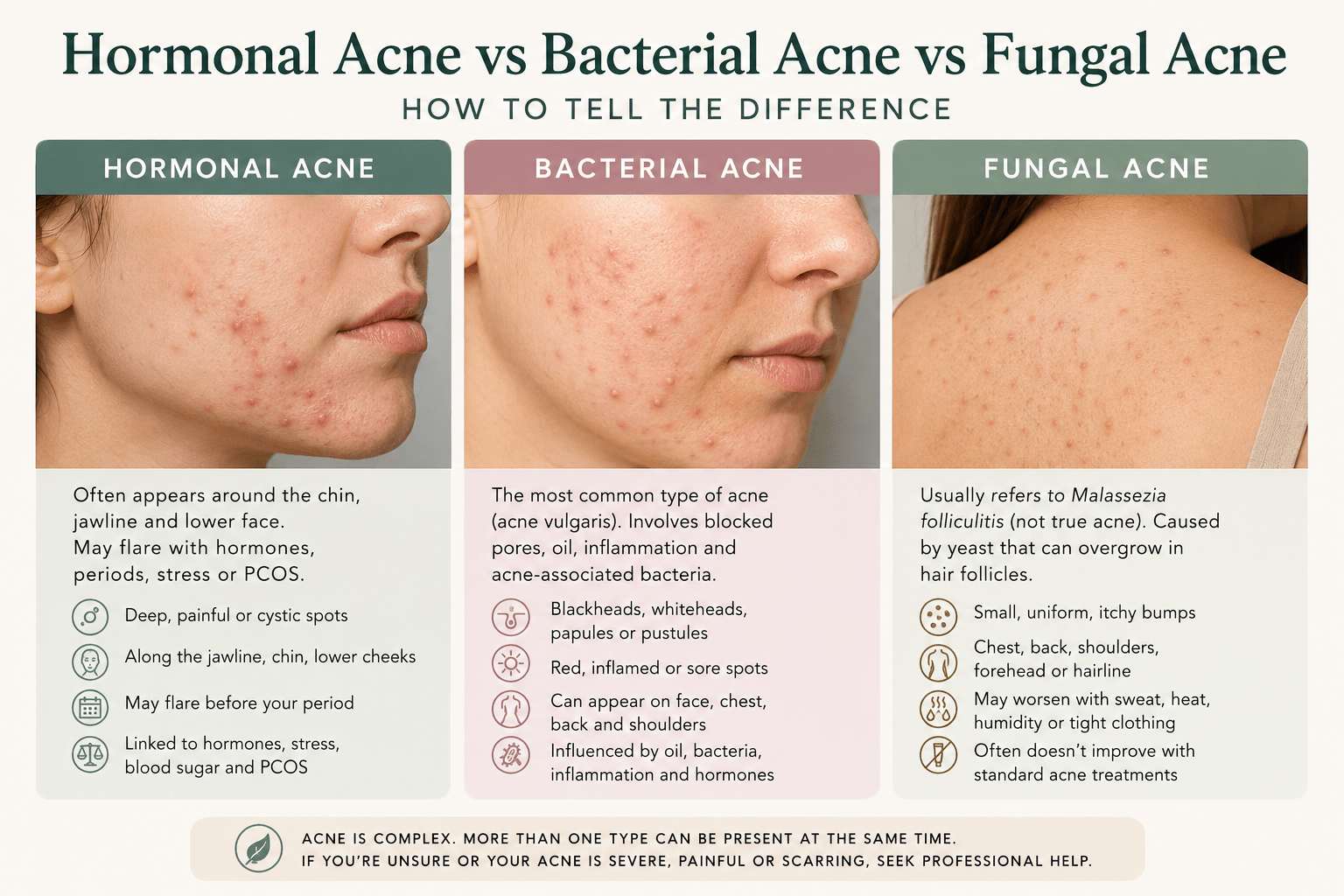
Quick Comparison: Hormonal, Bacterial and Fungal Acne
⚖️ Hormonal Acne
Acne vulgaris that appears to be strongly influenced by hormone activity. It may involve deeper inflammatory lesions and can occur around the lower face, neck, chest or back.
🦠 “Bacterial Acne”
Usually inflammatory acne vulgaris involving blocked follicles, sebum, inflammation and acne-associated bacteria. Blackheads, whiteheads, papules and pustules may occur together.
🍄 “Fungal Acne”
Usually Malassezia folliculitis. It commonly causes small, similar-looking and often itchy bumps on the upper chest, back, shoulders, forehead or hairline.
🌿 Good to Know
These labels are not always separate diagnoses. Hormonal influences and acne-associated bacteria are both part of acne vulgaris, while Malassezia folliculitis is a different acne-like condition.
What Is Hormonal Acne?
Hormonal acne is acne vulgaris that appears to be strongly influenced by hormonal activity, particularly androgens.
Androgens are naturally present in all bodies. They can increase activity within the sebaceous glands and contribute to increased sebum production, follicular blockage and inflammation (Reynolds et al., 2024).
Hormonal acne can affect men and women. It is not exclusively a women’s health issue.
Breakouts sometimes associated with hormonal patterns may appear around the:
- Chin
- Jawline
- Lower cheeks
- Neck
- Chest
- Back
However, location alone cannot confirm that acne is hormonal. Jawline or chin acne can also be influenced by shaving, beard products, skincare, friction, stress and other acne mechanisms.
Some people notice that acne worsens around menstrual cycle changes, during stress, following poor sleep or alongside other hormone-related symptoms.
🔎 Signs Hormonal Factors May Be Worth Exploring
- Breakouts that repeatedly affect the chin, jawline or lower face
- Acne that consistently changes with the menstrual cycle, where relevant
- Deep, sore or cystic breakouts
- Adult acne that keeps returning
- Acne alongside irregular or absent periods, where relevant
- Oily skin alongside other hormone-related symptoms
- Possible PCOS symptoms, such as excess hair growth or thinning scalp hair
- Breakouts that worsen during periods of stress or disrupted sleep
These signs do not diagnose hormonal acne or PCOS. Speak to a GP if acne appears alongside irregular periods, excess hair growth, fertility concerns or other significant hormonal symptoms.
You may also find
Foods for Hormonal Acne,
Acne and PCOS,
Chin Acne and
Jawline Acne helpful.
What Is “Bacterial Acne”?
The phrase “bacterial acne” is widely used online, but acne vulgaris is not simply an infection caused by unclean skin.
Acne vulgaris develops through several interacting processes:
- Increased sebum production
- Abnormal build-up of skin cells within the follicle
- Blocked pores
- Inflammation
- Activity involving Cutibacterium acnes
- Hormonal and genetic influences
Cutibacterium acnes naturally forms part of the skin microbiome. Within a blocked, oil-rich follicle, interactions between the bacteria, the skin and the immune system can contribute to inflammation (Reynolds et al., 2024).
This is why inflammatory acne vulgaris is a more accurate description than treating “bacterial acne” as a simple surface infection.
💡 In Plain English
Having acne-associated bacteria on your skin does not mean your skin is dirty. Acne develops when blocked pores, oil, skin-cell turnover, inflammation, hormones and bacteria interact.
Signs Acne Vulgaris May Be Involved
Acne vulgaris may include a mixture of:
- Blackheads
- Whiteheads
- Red inflammatory bumps
- Pustules with a white or yellow centre
- Deeper nodules
- Cysts
- Breakouts affecting the face, chest, back or shoulders
The presence of blackheads and whiteheads can help distinguish acne vulgaris from Malassezia folliculitis, which does not usually produce comedones (DermNet, n.d.-a; Chalupczak and Lipner, 2025).
If you are unsure which type of acne lesion you have, read
Different Types of Acne.
For treatment options, read
Acne Treatments & Skincare.
What Is Fungal Acne?
“Fungal acne” is an informal name commonly used for
Malassezia folliculitis, previously called pityrosporum folliculitis.
Malassezia are yeasts that normally live on human skin. Under certain conditions, they can proliferate within hair follicles and cause an acne-like eruption (DermNet, n.d.-a).
Malassezia folliculitis is not acne vulgaris. Although the bumps can look similar, the underlying condition and appropriate management may differ.
🔬 Research Snapshot
Malassezia folliculitis commonly presents as small, uniform and itchy follicular papules or pustules. It often affects the upper chest, back and shoulders, although the forehead, hairline, chin, neck and upper arms may also be involved. Unlike acne vulgaris, comedones are generally absent (DermNet, n.d.-a; Chalupczak and Lipner, 2025).
Signs Malassezia Folliculitis May Be Worth Considering
🔎 Possible Malassezia Folliculitis Clues
- Small bumps that look very similar in size and shape
- Itching or irritation
- Breakouts on the chest, upper back, shoulders, forehead or hairline
- Worsening with heat, humidity, sweating or occlusive products
- Few or no blackheads and whiteheads
- Breakouts that have not improved with usual acne treatment
- A history of antibiotic use, steroid use or immunosuppression
Risk factors reported for Malassezia folliculitis include hot and humid conditions, high sebum production, excessive sweating, occlusive skincare products, antibiotic exposure and immunosuppression (DermNet, n.d.-a).
These signs do not confirm Malassezia folliculitis. Diagnosis can require clinical examination and, where necessary, skin scraping, microscopy, dermoscopy or other investigations (DermNet, n.d.-a; Chalupczak and Lipner, 2025).
⚠️ Do Not Self-Diagnose Fungal Acne
Several conditions can produce itchy or uniform bumps. Avoid repeatedly applying antifungal products or taking antifungal medication without professional advice.
Oral antifungal medicines can cause side effects and interact with other medication. A GP, pharmacist or dermatologist can help determine whether the bumps are acne vulgaris, Malassezia folliculitis, bacterial folliculitis or another skin condition.
Hormonal vs Bacterial vs Fungal Acne: Key Differences
📍 Common Locations
Hormonal pattern: Often discussed in relation to the chin, jawline, lower face, neck, chest or back.
Acne vulgaris: Commonly affects the face, chest and back.
Malassezia folliculitis: Often affects the upper chest, upper back, shoulders, forehead or hairline.
🔎 Appearance
Hormonal pattern: May involve deeper, painful or cystic lesions, but appearances vary.
Acne vulgaris: May include blackheads, whiteheads, papules, pustules, nodules and cysts.
Malassezia folliculitis: Typically produces small, uniform follicular papules or pustules without comedones.
💬 Symptoms
Hormonal pattern: May be sore, tender or inflamed.
Acne vulgaris: Can be painless, tender or painful depending on lesion type.
Malassezia folliculitis: Itching is a common feature.
⏱️ Common Patterns
Hormonal pattern: May change with hormonal events, stress or menstrual cycle timing.
Acne vulgaris: May persist with congestion, oiliness and inflammatory lesions.
Malassezia folliculitis: May worsen with heat, sweating, humidity or occlusion.
⚫ Comedones
Hormonal acne: May occur alongside blackheads or whiteheads because it remains acne vulgaris.
Acne vulgaris: Blackheads and whiteheads are common.
Malassezia folliculitis: Blackheads and whiteheads are generally absent.
🧴 Treatment Response
Hormonal pattern: May not respond fully to skincare alone.
Acne vulgaris: May respond to appropriate evidence-based acne treatment.
Malassezia folliculitis: May not respond to standard acne treatment and can require professionally guided antifungal management.
Can You Have More Than One Type?
Yes.
Hormones, follicular blockage, inflammation and
Cutibacterium acnes can all contribute to the same case of acne vulgaris. These are not necessarily separate types.
It is also possible for acne vulgaris and Malassezia folliculitis to coexist. This can make the skin pattern more difficult to interpret (Chalupczak and Lipner, 2025).
For example:
- Someone may have deeper cycle-related jawline acne alongside comedonal forehead acne.
- Someone may have acne vulgaris on the face and Malassezia folliculitis across the chest or upper back.
- Someone may have inflamed acne alongside shaving-related bacterial folliculitis.
🌿 Good to Know
You do not need to fit neatly into one label. Acne can involve several drivers, and acne-like conditions can occur alongside it. The lesion type, symptoms, triggers and response to treatment all matter.
What Else Can Look Like Acne?
Not every red bump or pustule is acne.
Conditions that can resemble acne include:
- Malassezia folliculitis
- Bacterial folliculitis
- Rosacea
- Perioral dermatitis
- Keratosis pilaris
- Steroid acne
- Medication-related acneiform eruptions
- Contact dermatitis or skincare irritation
Rosacea may involve flushing, visible blood vessels or eye symptoms, while Malassezia folliculitis commonly lacks blackheads and is often itchy. These features can help guide assessment, but they are not a substitute for diagnosis (DermNet, n.d.-b).
How Treatment May Differ
Treatment should be based on the diagnosed condition rather than the label someone has given their breakouts.
⚖️ Hormonal Patterns
Management may involve evidence-based acne treatment alongside assessment of menstrual, PCOS or other hormone-related symptoms where relevant.
🦠 Acne Vulgaris
Treatment may involve topical retinoids, benzoyl peroxide, azelaic acid or combination treatments. Moderate-to-severe acne may require prescription oral treatment (NICE, 2026).
🍄 Malassezia Folliculitis
Management may involve reducing contributing factors and using topical or oral antifungal treatment under appropriate professional guidance (DermNet, n.d.-a).
Do not stop prescribed medication or begin prescription-strength treatment without speaking to the relevant healthcare professional.
For an overview of recognised acne treatments, read
Acne Treatments & Skincare.
When to Speak to a GP or Dermatologist
NICE recommends considering acne severity, distribution, scarring risk, treatment response and effects on psychological wellbeing when deciding on management or referral (NICE, 2026).
⚠️ Seek Medical Support If
- Your acne is painful, nodular, cystic or leaving scars
- Your breakouts are spreading quickly
- Your skin is very itchy, crusting or looks infected
- You develop sudden acne-like bumps after starting medication
- Your breakouts are not improving with suitable treatment
- You suspect Malassezia folliculitis but are unsure
- Your skin is affecting your confidence or mental wellbeing
Nutritional therapy can support the wider health picture, but it should not replace appropriate medical diagnosis or treatment where acne is severe, scarring, infected-looking or unclear.
How Nutrition and Lifestyle May Fit In
Nutrition and lifestyle do not replace evidence-based dermatological care. However, they may support the wider factors that influence acne-prone skin.
Areas that may be relevant include:
- Blood sugar balance
- Diet quality
- Gut health and digestion
- Nutrient status
- Stress and sleep
- Hormone-related symptoms
- Personal food triggers
- Skincare and product choices
If acne appears alongside digestive symptoms, read
Can Gut Health Cause Acne? and
The Gut-Skin Axis.
If you suspect food-related triggers, read
Foods That May Trigger Acne.
For a broader explanation of the different factors involved in acne, read
What Causes Acne?.
What This Means For You
Hormonal acne, inflammatory acne vulgaris and Malassezia folliculitis may look similar, but the labels do not tell the whole story.
Hormonal acne remains acne vulgaris. Hormones may influence oil production and inflammation, but blocked pores, skin-cell turnover and acne-associated bacteria can still be involved.
“Bacterial acne” is usually acne vulgaris rather than a straightforward bacterial infection.
“Fungal acne” usually describes Malassezia folliculitis, which is a different acne-like follicular condition.
Look at the full pattern:
- Are the bumps itchy or painful?
- Do they all look similar?
- Are blackheads or whiteheads present?
- Do breakouts change with stress or hormonal events?
- Do heat, sweat or occlusive products make them worse?
- Have suitable acne treatments helped?
These details can help guide a conversation with a GP, pharmacist or dermatologist.
Frequently Asked Questions
How do I know if my acne is hormonal?
Hormonal influences may be worth considering when acne repeatedly changes with hormonal events, affects the lower face, feels deep or painful, or appears alongside other hormone-related symptoms. However, location alone cannot diagnose hormonal acne.
Is bacterial acne caused by dirty skin?
No. Acne vulgaris involves blocked follicles, sebum, inflammation, skin-cell turnover, hormones, genetics and acne-associated bacteria. Over-cleansing can irritate the skin and does not remove the underlying causes of acne.
What does fungal acne look like?
Malassezia folliculitis often appears as small, similar-looking and itchy follicular bumps. It commonly affects the chest, upper back, shoulders, forehead or hairline, and blackheads are usually absent.
Can fungal acne appear on the face?
Yes. Malassezia folliculitis can affect the forehead, hairline, chin or neck, although the upper chest, back and shoulders are common locations.
Can I have acne vulgaris and fungal acne together?
Yes. Acne vulgaris and Malassezia folliculitis can coexist. This is one reason professional assessment may be useful when breakouts have mixed features or do not respond as expected.
Should I use antifungal cream if I think I have fungal acne?
It is best to speak to a pharmacist, GP or dermatologist before treating suspected Malassezia folliculitis. Other conditions can look similar, and the most appropriate treatment depends on the diagnosis, location, severity and your wider health circumstances.
When should I get help for acne?
Seek support if your acne is painful, nodular, cystic, scarring, spreading, very itchy, unusual-looking, affecting your wellbeing or not improving with appropriate treatment.
Final Thoughts
Hormonal acne, “bacterial acne” and “fungal acne” are widely used terms, but they can oversimplify what is happening in the skin.
Hormonal acne is acne vulgaris that appears strongly influenced by hormone activity.
“Bacterial acne” generally refers to inflammatory acne vulgaris, where blocked follicles, sebum, inflammation and acne-associated bacteria interact.
“Fungal acne” usually refers to Malassezia folliculitis, which is an acne-like condition rather than true acne.
The most useful question is not only:
“Which label matches my skin?”
It is:
“What features, triggers and underlying processes are contributing to my particular breakout pattern?”
Need Help Understanding Your Acne Pattern?
If you are struggling with persistent breakouts and feel unsure whether hormones, gut health, inflammation, stress, diet or wider health factors may be involved, you do not have to keep guessing.
At VitaminBeth, we use a personalised, root-cause approach to explore factors that may contribute to acne alongside appropriate medical and skincare support.
Learn more about the Skin Therapy Programme
📚 Continue Your Acne Learning
You’re reading one of VitaminBeth’s acne guides. Visit the Acne Resource Centre to explore all of our evidence-informed articles on acne causes, hormones, gut health, nutrition, lifestyle and personalised support in one place.
References
- Chalupczak, N.V. and Lipner, S.R. (2025) ‘Malassezia folliculitis: An underdiagnosed mimicker of acneiform eruptions’, Journal of Fungi, 11(9), p. 662. Available at: https://pmc.ncbi.nlm.nih.gov/articles/PMC12471122/
- DermNet (n.d.-a) ‘Malassezia folliculitis’. Available at: https://dermnetnz.org/topics/malassezia-folliculitis (Accessed: 26 July 2026).
- DermNet (n.d.-b) ‘Acne mimics: What else could it be?’. Available at: https://dermnetnz.org/topics/acne/acne-mimics-what-else-could-it-be (Accessed: 26 July 2026).
- National Institute for Health and Care Excellence (NICE) (2026) ‘Acne vulgaris: management’. NICE guideline NG198, originally published 2021 and updated 30 April 2026. Available at: https://www.nice.org.uk/guidance/ng198
- Reynolds, R.V. et al. (2024) ‘Guidelines of care for the management of acne vulgaris’, Journal of the American Academy of Dermatology, 90(5), pp. 1006.e1–1006.e30. Available at: https://pubmed.ncbi.nlm.nih.gov/38300170/
- Rubenstein, R.M. and Malerich, S.A. (2014) ‘Malassezia (Pityrosporum) folliculitis’, Journal of Clinical and Aesthetic Dermatology, 7(3), pp. 37–41. Available at: https://pmc.ncbi.nlm.nih.gov/articles/PMC3970831/